For ten years, Leonard Whitmore lay silent in Room 701 while doctors gave up hope. Then a barefoot boy walked in with rain-soaked earth in his hands and did the one thing no expert ever dared.
For ten years, Leonard Whitmore had not opened his eyes.
His name still meant power. Hospitals carried his donations. Companies carried his signature. Newspapers still called him one of the richest men in the country.
But none of that mattered in Room 701.
There, Leonard was only a motionless body beneath white sheets, surrounded by machines that breathed, beeped, and waited. Doctors had tried everything. Specialists came from overseas, studied his charts, whispered carefully, and left with the same answer.
No meaningful response.
No sign of return.
That morning, his medical team gathered to sign the papers for transfer. Not to end his life, but to move him away from advanced treatment. After ten years, even hope had become too expensive to keep pretending.
That was the day Malik walked in.
He was eleven years old, small for his age, and often barefoot. His mother cleaned hospital floors at night, and after school, Malik waited in the hallways because they had nowhere safer to go.
He knew which vending machines stole coins. Which nurses smiled. Which rooms were forbidden.
Room 701 was one of them.
But that afternoon, a storm flooded the neighborhood. Malik arrived soaked, with mud on his knees and rainwater dripping from his sleeves. Security was distracted. The door to Room 701 was not locked.
So Malik stepped inside.
Leonard looked the same as always — pale, still, sealed away from the world.
Malik stood beside the bed for a long moment.
“My grandma was like this,” he whispered. “They said she was gone too. But I talked to her. I think she heard me.”
He climbed onto the chair and looked at the billionaire’s silent face.
“People talk like you’re not here,” Malik said softly. “That must feel lonely.”
Then he reached into his pocket.
In his small hand was a handful of dark, rain-soaked earth.
Slowly, gently, Malik spread the mud across Leonard’s cheeks, forehead, and the bridge of his nose.
“Don’t be mad,” the boy whispered. “My grandma said the ground remembers us, even when people forget.”
A nurse walked in and froze.
“What are you doing?”
Malik jumped back in terror. Security rushed in. Doctors shouted. The boy cried and apologized as they pulled him away, his muddy hands shaking.
The medical team was furious. The room had been contaminated. The patient had been touched by a child with dirt from outside.
They began cleaning Leonard’s face at once.
Then the monitor changed.
One sharp beep.
Then another.
A doctor stopped moving.
“Wait,” he said. “Look at his hand.”
Leonard’s fingers twitched.
The room went silent.
Within hours, the signs grew stronger. His pupils reacted. His muscles responded. His brain activity changed in a way no one had seen in ten years.
Three days later, Leonard Whitmore opened his eyes.
The first thing he said was not about money.
It was not about business.
It was about rain.
“I smelled it,” he whispered. “Rain. Dirt. My father’s hands. The farm where I grew up.”
The hospital searched for Malik.
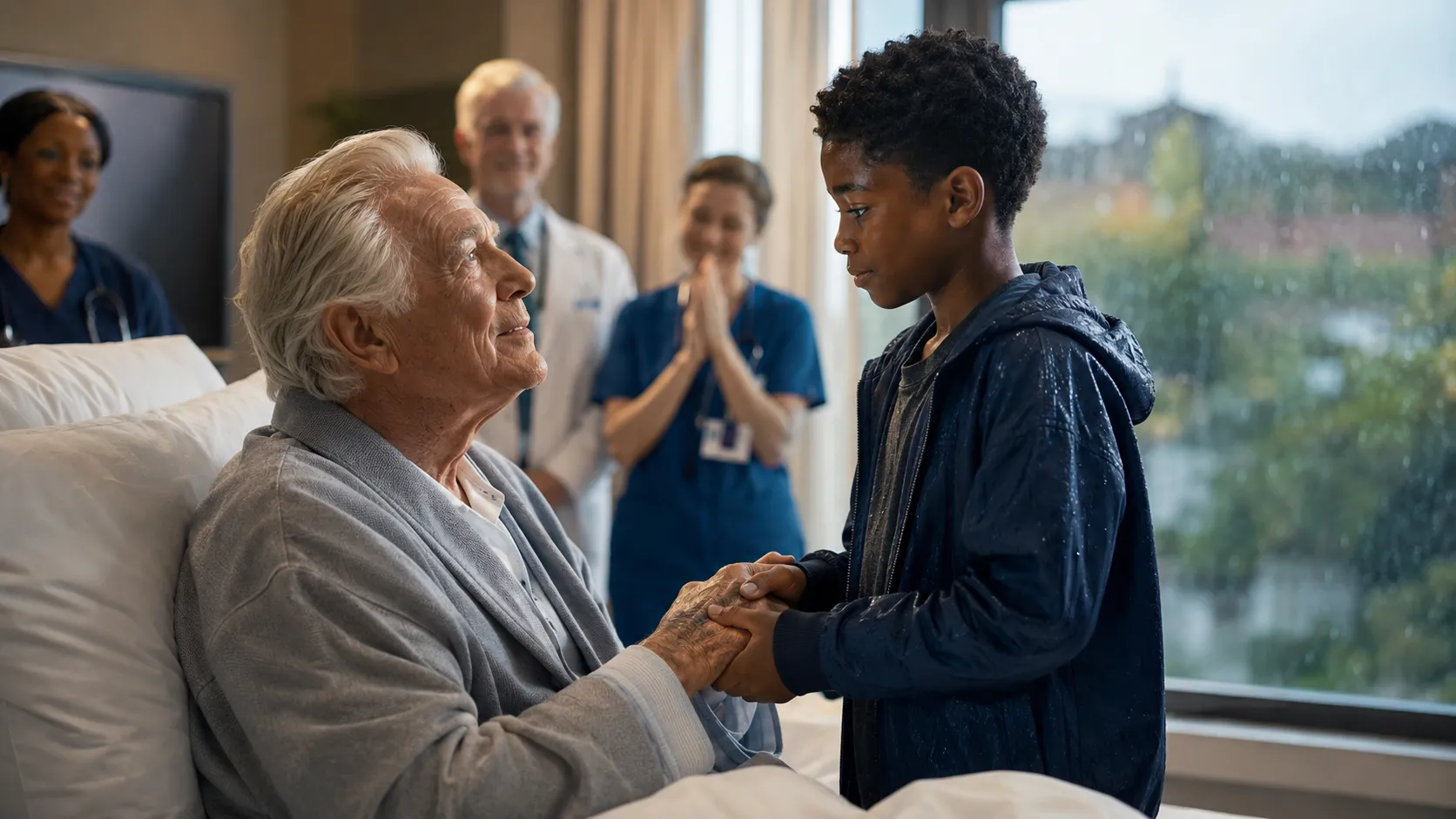
When they finally brought him back, the boy stood by the door with his head down.
“I’m sorry,” he whispered. “I didn’t want to hurt him.”
Leonard reached for his hand.
“You reminded me I was still alive,” he said. “Everyone else treated me like a body. You treated me like I still belonged to the world.”
Malik began to cry.
Leonard later paid his mother’s debts, gave her a proper home, and sent Malik to school. He also built a community center in the boy’s neighborhood, not with his name carved in gold, but with one simple sentence above the door:
No one is forgotten here.
Reporters called it a miracle.
Doctors called it unexplained.
But Leonard never used complicated words.
Whenever people asked what woke him, he gave the same answer.
“A poor boy came into my room with mud in his hands,” he said. “And for the first time in ten years, someone touched me like I was still human.”
And Malik?
He still believed what his grandmother told him.
The ground remembers us.
Even when the world does not.