For five years, Isabella believed her son was gone forever. Then one rainy afternoon, she pushed away a homeless child… and noticed the birthmark that shattered her world.
Five years had passed since Isabella Rinaldi’s life broke in two.
Once, she had been known across Milan as a graceful woman, a devoted mother, and one of the most powerful figures in Italian fashion. But all of that changed the day her only son, Lorenzo, vanished outside their home.
He was seven years old.
There was no ransom call. No witness who could explain it. No camera that gave a clear answer. One moment Lorenzo had been there, smiling beside the gate. The next, he was gone.
Isabella spent millions trying to find him. Private investigators. Search teams. Reward posters. Television appeals. Every lead ended the same way: silence.
And slowly, her grief hardened into something colder.
She stopped smiling. She stopped trusting people. She hid her pain behind white suits, perfect hair, luxury cars, and a voice sharp enough to silence any room.
People called her strong.
But the truth was simpler.
She was broken.
One rainy afternoon in Rome, Isabella stepped out of her white Rolls-Royce in front of Il Cristallo, an exclusive restaurant where celebrities, politicians, and executives came to be seen. She wore an elegant white designer suit, flawless from collar to hem.
The sidewalks were crowded with umbrellas. Water ran along the curb. Reporters waited near the entrance.
Then a boy darted past her.
He was about nine, maybe ten. His clothes were soaked and torn. His shoes were too small. In one hand, he held a paper bag filled with leftovers from a trash bin.
He slipped on the wet pavement and crashed into Isabella.
Dirty water splashed across her white skirt.
A gasp moved through the crowd.
The boy froze.
“I’m sorry,” he whispered. “I didn’t mean to. I was only trying to get food.”
Isabella stared down at the stain, then at him. For a moment, all the pain she had buried for years rose inside her as anger.
“Do you know what this suit costs?” she snapped.
The child lowered his eyes. “No, ma’am.”
“It costs more than your whole life.”
The words were cruel enough to stop the people around them. A few phones lifted. Someone began recording.
The boy stepped back, trembling.
But Isabella, blinded by rage and humiliation, pushed him away.
He fell into a puddle, his small hands hitting the cold pavement.
The crowd went silent.
Then Isabella saw it.
On the boy’s left wrist, half-hidden beneath rain and mud, was a small crescent-shaped birthmark.
Her breath stopped.
Lorenzo had the same mark.
The same shape. The same place.
The boy slowly stood, soaked and shaking. He did not scream. He did not curse her. He simply picked up his ruined bag of food and whispered, “I’m sorry, lady. I only eat what people leave behind.”
Then he walked away in the rain.
That night, Isabella did not sleep.
She saw his wrist every time she closed her eyes. She heard his voice. She remembered the softness in his face, the quiet sadness, the way he had looked at her without hate.
At dawn, she called her most trusted assistant.
“Find that boy,” she said. “The one from yesterday.”
Two days later, the answer came.
The boy was known as Elia. No birth certificate. No school records. No medical papers. He slept near the San Lorenzo district and was cared for by an old homeless man named Vittorio.
That evening, Isabella removed her jewelry, put on a plain coat, and walked through the cold streets until she found them beneath a narrow shelter of cardboard and plastic.
Elia was asleep, curled under a thin blanket.
Beside him sat Vittorio, tired and watchful.
“You’re looking for the boy,” the old man said.
Isabella nodded, unable to speak.
“He’s a good child,” Vittorio said. “He doesn’t remember much. Only that his mother would come back someday. And he never lets go of that necklace.”
Isabella looked down.
Around the boy’s neck hung a worn silver pendant.
One word was engraved on it.
LORENZO.
The world blurred.
Three days later, a DNA test confirmed what her heart already knew.
Elia was Lorenzo.
Her son.
The child she had spent five years searching for was alive — hungry, homeless, and sleeping on the streets.
And she had pushed him into the mud.
Isabella fell to her knees when she read the result. For the first time in years, she cried without trying to hide it.
But when she arranged to bring him safely to a shelter, Elia ran away. He had heard adults talking about moving him and panicked.
Isabella forgot her driver, her security, her reputation. She ran through the rain, calling both names.
“Elia! Lorenzo! Please!”
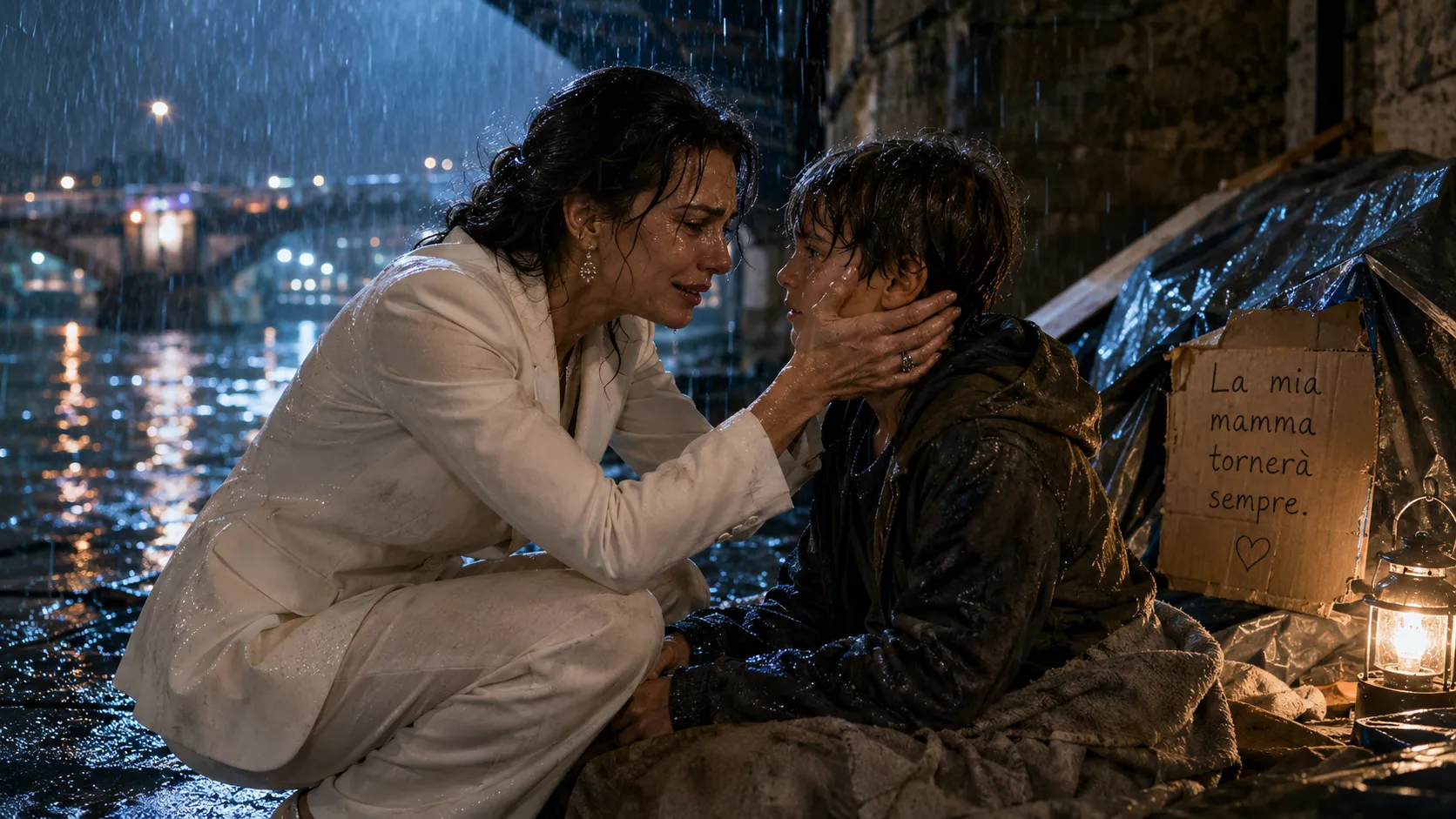
Hours later, she found him under a bridge.
He was sitting beside Vittorio, who lay still beneath an old blanket.
“He died last night,” the boy whispered. “He always told me my mother would come back. But she never did.”
Isabella dropped to her knees in front of him.
“I did come back,” she said, her voice breaking. “I am your mother, Lorenzo. I never stopped looking for you.”
The boy stared at her.
“But you hurt me.”
Those four words cut deeper than anything Isabella had ever survived.
“I know,” she whispered. “And I can’t erase it. But if you let me, I will spend the rest of my life trying to make it right.”
For a long moment, only the rain spoke.
Then the boy lifted his small hand and touched her face.
“You came back,” he said.
Isabella pulled him into her arms and held him as if the whole world had finally returned.
Months later, she opened a foundation for missing children and families who had lost hope.
But every year, when the rain returns, Isabella and Lorenzo visit the bridge together.
Not to remember the pain.
To remember the miracle.
Because love can lose its way.
But when it is real… it comes back.