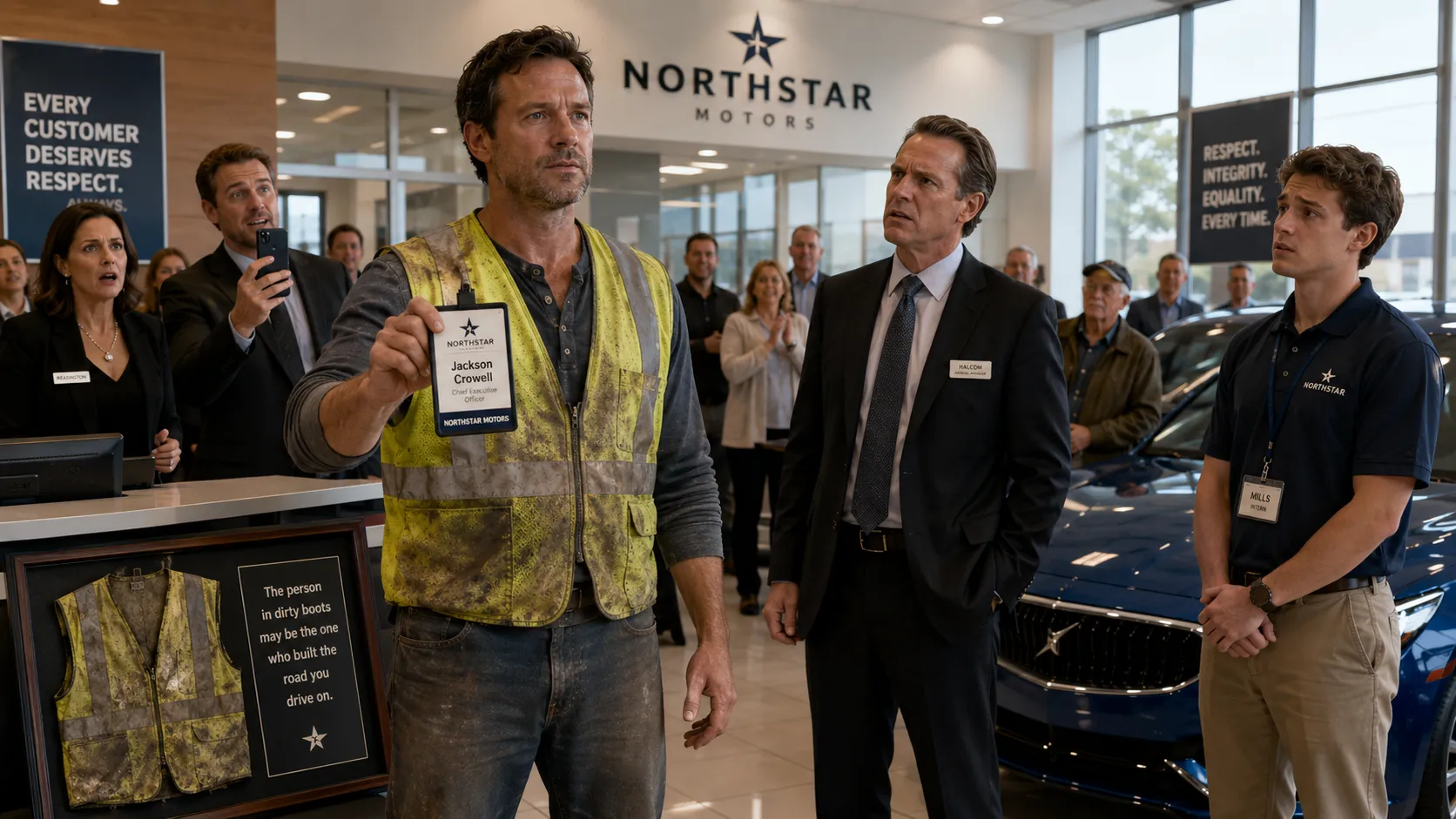
Jackson entered Northstar Motors in dusty boots and a faded safety vest, and the showroom laughed before asking his name. Minutes later, he pulled out his CEO badge, and the people who judged him by his clothes went silent.
Jackson Crowell had spent three weeks reading letters that made him ashamed of his own name.
Northstar Motors was the dealership empire his father had helped build from one small garage, one toolbox, and one rule: every customer deserved respect before they showed their wallet.
But the letters said Northstar had forgotten that.
A truck driver wrote that he was told the new models were “not for people like him.”
A retired teacher said no one would speak to her because she came in with a coupon folder.
One sentence stayed with Jackson most:
They made me feel poor before they even asked my name.
That night, Jackson stood in his closet and pushed aside the expensive suits. At the back hung his late father’s old reflective safety vest, faded and frayed at the seams.
He put it on.
In the mirror, the CEO disappeared.
A tired roadworker stared back.
The next morning, Jackson walked into the Northstar showroom wearing dusty boots, worn jeans, and the safety vest. Luxury cars shone beneath white lights. Salespeople stood beside polished desks, smiling at customers who looked expensive.
Then they saw him.
The receptionist, Ms. Readington, looked him up and down.
“This is a private showroom,” she said. “Are you looking for the service entrance?”
Jackson kept his voice polite.
“I wanted to ask about the blue sedan.”
A salesman named Doyle laughed softly.
“That model starts higher than most construction crews make in a year.”
Another employee, Clyde, lifted his phone and began recording.
“Look at this,” he said. “Guy in work boots thinks he’s buying luxury.”
Laughter moved across the showroom.
Jackson looked from face to face, giving each person one final chance to be decent.
Only one took it.
A young intern named Mills stepped forward, nervous but sincere.
“Sir,” he said quietly, “I can show you the features if you’d like.”
Readington snapped at him. “Mills, go organize the brochure wall.”
Mills flushed but looked back at Jackson.
“I’m sorry,” he whispered. “They shouldn’t speak to you that way.”
That was the only kindness in the room.
Then the general manager, Halcom, came out of his glass office. He moved with the confidence of a man used to being obeyed.
“This dealership has standards,” he said. “If you are not here to buy, you are disrupting business.”
“I asked about financing,” Jackson replied.
Halcom folded his arms.
“You are not our target customer.”
The words landed like a verdict.
Jackson looked around the showroom — at the smirks, the phones, the employees who stayed silent, and the customers watching an ordinary-looking man be humiliated for entertainment.
Then he removed his hard hat and placed it on a chair.
Slowly, he reached into his vest pocket.
Everyone expected him to leave.
Instead, he pulled out a badge.
Jackson Crowell
Chief Executive Officer
Northstar Motors
The showroom froze.
Clyde’s phone dropped to his side.
Readington’s mouth opened, but no words came.
Halcom stepped back as if the badge had struck him.
Jackson’s voice stayed calm.
“I have received complaints for months. Today I came to learn whether they were exaggerated.”
He looked at Readington first.
“You were the first face a customer saw. You made sure he felt unwelcome before he reached the desk. Effective immediately, you are no longer employed here.”
Then he turned to Clyde.
“You turned a person into a joke for your phone. Your contract ends today.”
Finally, he faced Halcom.
“This culture did not appear by accident. It was allowed from the top.”
Halcom tried to recover. “Mr. Crowell, we were protecting the brand.”
Jackson’s expression hardened.
“No. You were protecting your prejudice.”
He dismissed him on the spot.
The room stayed silent.
Then Jackson called the intern forward.
“Mills.”
The young man looked terrified.
“You apologized when you believed I was only a construction worker,” Jackson said. “That is when character matters most.”
Mills swallowed. “I just thought it was wrong.”
“That is why you are entering the full sales training program. I will oversee it personally.”
A few customers began to clap. Others looked down, ashamed that they had watched and done nothing.
Jackson turned to everyone in the showroom.
“From today forward, Northstar will not judge customers by shoes, coats, accents, jobs, or bank balances. Every person who walks through these doors will be treated like they belong here until they prove otherwise.”
An older man near the doorway raised his hand.
“I came here last year,” he said softly. “They told me I should try a used lot across town. I never came back.”
Jackson walked to him and shook his hand.
“I’m sorry,” he said. “You should never have been treated that way.”
Then he pointed toward the blue sedan.
“Would you like to see it?”
The old man’s eyes filled.
“Yes,” he whispered. “I always did.”
That day did not end with a big sale.
It ended with something more important.
A change.
The showroom where people had once been measured by clothing began to measure staff by dignity. Mills later became one of Northstar’s best managers, not because he knew every engine specification, but because he never forgot what it felt like to defend someone no one else respected.
And Jackson hung his father’s old vest in the main office, framed behind glass.
Under it, he placed one sentence:
The person in dirty boots may be the one who built the road you drive on.