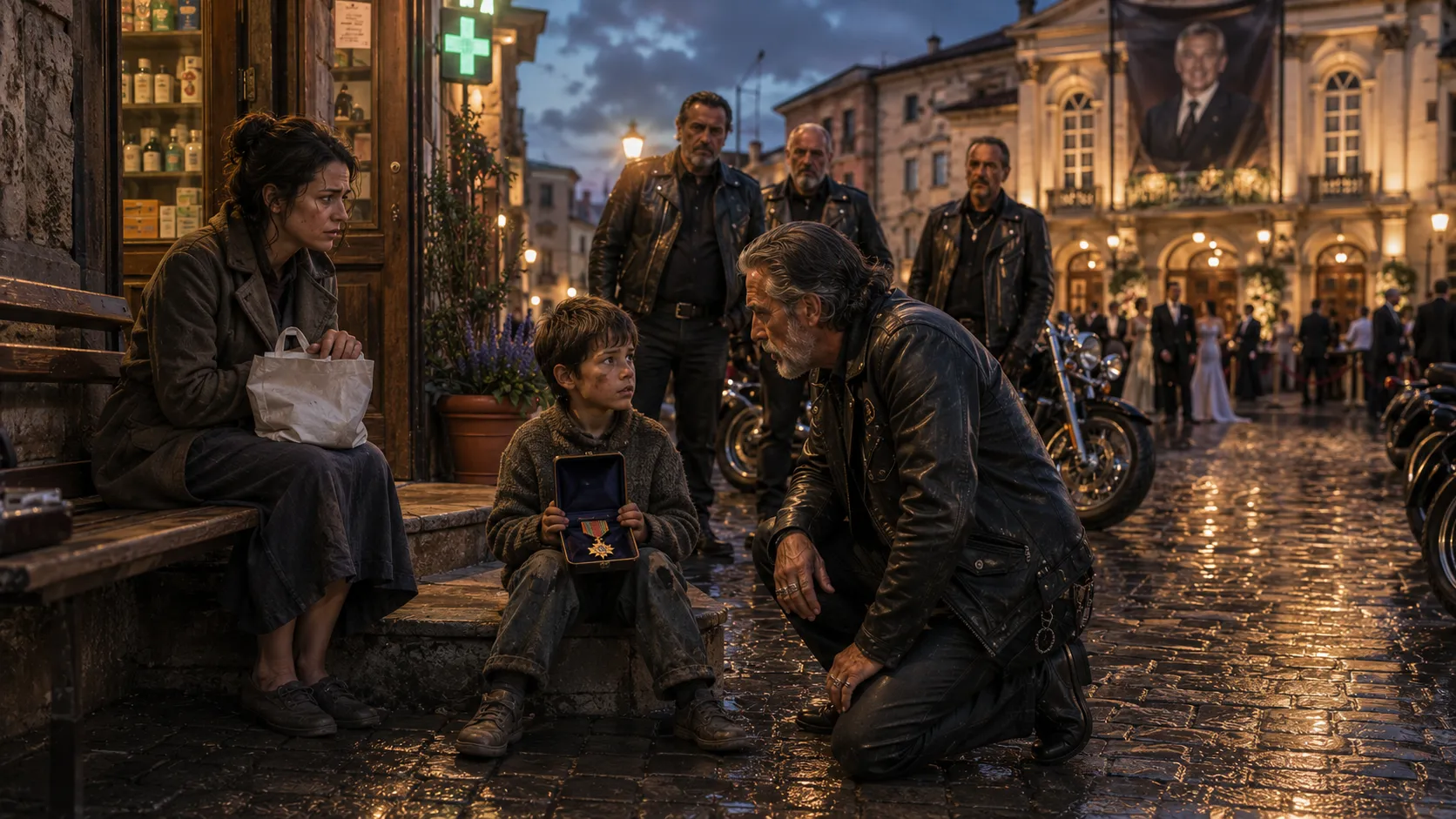
Tommaso only wanted enough money to buy his mother’s insulin. But when the bikers saw his father’s medal beside a gala poster honoring that same dead hero, they realized the boy was standing in the middle of a lie the whole town had helped believe.
The medal looked too heavy for the boy holding it.
Rocco noticed it as the Red Hawks rolled into Piazza Bellini just after five. The boy sat on the pharmacy steps with a cracked velvet box in his lap and a cardboard sign against his knees.
FOR SALE
MY DAD’S MEDAL
He could not have been older than nine. His sweater was patched, his shoes were worn, and his face had the stillness of a child trying not to cry in public.
Rocco stopped his motorcycle. The others stopped with him.
Across the square, people in evening clothes were entering the municipal theater. Above the doors hung a glossy banner with the smiling face of businessman Alessandro Vieri.
HEROES NEVER FORGOTTEN GALA
Benefiting the Marco Rinaldi Family Hero Fund
Rocco looked at the banner.
Then at the medal.
He knew the name Marco Rinaldi.
Twelve years earlier, Marco had run back into Vieri’s burning warehouse to save trapped workers. He dragged two men out. On the second return, the roof collapsed.
The town called him a hero. Alessandro Vieri cried for the cameras and promised Marco’s widow and infant son would never be abandoned.
Now that son was sitting outside a pharmacy trying to sell his father’s medal.
Rocco crouched in front of him.
“What’s your name?”
“Tommaso.”
“How much for the medal?”
The boy swallowed. “I don’t know. I just need enough.”
“For what?”
Tommaso looked toward the pharmacy awning.
“For my mama’s insulin.”
No one spoke.
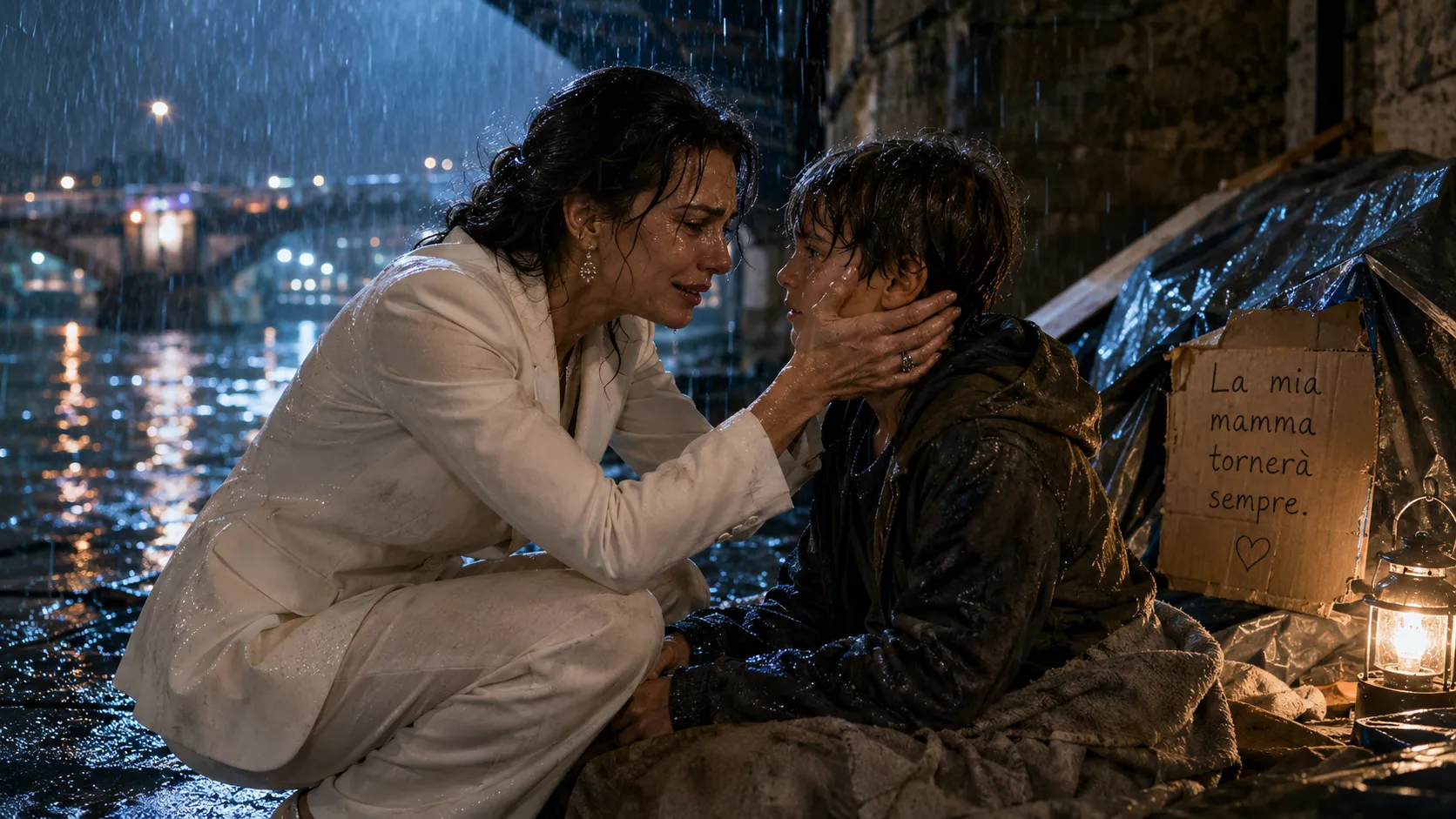
Under the awning, a pale woman sat on a bench, both hands trembling over an empty pharmacy bag. Her coat was clean but old, and a torn catering pass still hung from one seam.
Rocco walked over.
“You worked at the gala?”
The woman gave a tired nod.
“Until an hour ago. I’m Sofia Rinaldi.”
An envelope slipped from her coat. Rocco picked it up.
Inside was a termination notice.
Immediate dismissal for misconduct.
The second page was worse.
It was an invoice for champagne, flowers, shellfish, and music. At the top, in bold letters, it said:
CHARGE TO: Marco Rinaldi Family Hero Fund
Rocco read it twice.
The man hosting a gala in Marco’s name had frozen the widow’s medicine card, fired her, and billed his luxury party to the fund meant to protect her family.
“When did you see this?” Rocco asked.
Sofia’s voice broke.
“When he handed me the wrong envelope. I asked why my husband’s fund was paying for champagne. He said men like Marco die once and should stop costing money afterward.”
Tommaso stared at the medal.
Rocco turned to one of the bikers.
“Buy the insulin.”
Then he looked at Tommaso.
“Close that box. We’re not selling your father.”
Minutes later, the Red Hawks entered the theater with Sofia and Tommaso behind them.
The foyer was filled with white roses, gold lights, champagne glasses, and donors praising themselves beneath Marco Rinaldi’s name.
On the stage stood a glass case.
Inside was a replica of Marco’s medal.
Rocco placed the real medal and the invoice on the display table.
Alessandro Vieri’s smile vanished.
“This is inappropriate,” he said.
Rocco looked at him calmly.
“So is billing oysters to a dead man’s hero fund.”
The room went quiet.
Vieri turned to the guests. “This is an accounting misunderstanding.”
Dario, one of the Red Hawks, stepped forward. He was one of the men Marco had saved from the burning warehouse.
“No,” Dario said. “I remember Marco carrying me through smoke. I remember you promising his wife would be cared for. And today his son was outside trying to sell his medal for insulin.”
Sofia raised her head.
“You cut off my medicine card three months ago. Today you fired me because I saw the invoices. My son stood outside trying to sell his father’s honor while you stood under his name asking for applause.”
That broke the room.
A hospital board member demanded the books. A councilman called for the treasurer. A journalist lifted her camera. One volunteer from the fire brigade began to cry.
Then Tommaso stepped toward the glass case and looked at the fake medal.
“That one isn’t his,” he said.
Everyone turned.
The boy pointed to the real medal on the table.
“You put my papa in a box. But you didn’t feed us.”
No one defended Alessandro after that.
By morning, the fund was frozen. By noon, every newspaper carried the same image: Tommaso beside the fake display medal while the real one lay next to the invoice.
The caption spread across Italy:
Hero’s Son Tried to Sell Medal for Mother’s Insulin While Fund Paid for Gala
Alessandro was charged with fraud, misuse of charity money, and wrongful dismissal. The town rebuilt the fund under new oversight.
The first rule was written on a wooden sign:
MARCO RINALDI FAMILY FUND
MEDICINE FIRST. SPEECHES LATER.
Months later, Tommaso stood at the memorial night in town hall. No champagne. No gold banners. No rich man borrowing another man’s sacrifice.
Just candles, damp coats, firefighters, neighbors, and his mother sitting stronger in the front row.
Tommaso carried the velvet box to the front.
This time, he was not selling the medal.
He pinned it beneath his father’s photograph.
The room stood and applauded, not loudly, but warmly — the way people do when something stolen is finally returned.
Rocco watched the boy smile at his mother.
And he understood why some stories spread.
Not because they are clever.
Because the wrong people became too comfortable, and then a child appeared with the one honest thing they could not buy.