Sheriff Mason thought five-year-old Leo was just causing trouble in the middle of a storm. But when the dam finally broke, the whole town learned that the boy’s silence had been warning them louder than any siren.
Sheriff Mason had served Blackwood Creek for twenty years.
He had seen wrecks, floods, fights, and families torn apart by grief. But nothing stayed with him like the night he ignored a five-year-old boy who could not speak.
The boy’s name was Leo.
He lived with his mother, Sarah, in the yellow house near the culvert. Leo did not talk. Doctors had names for it. The school had paperwork for it. But most of the town only had impatience.
They called him difficult.
Strange.
A menace.
Leo did not play with other children. He watched things. Cracks in sidewalks. Creek water under bridges. The way telephone wires trembled when the wind changed.
And that week, he watched the mountain.
Rain had fallen for seven straight days. The creek was swollen. Roads were soft. The old Shadow Ridge Dam stood above the town like a wall nobody wanted to think about.
County engineers told Mason it was holding.
“Within safety limits,” they said.
So Mason believed them.
Two days before the disaster, Mrs. Higgins called the station furious because Leo was stealing stones from her yard. When Mason arrived, the boy was dragging a rock through the mud with both hands, sweating with silent determination.
“Leo,” Mason said, stepping out into the rain, “put it back.”
Leo pointed toward the drainage ditch.
Then toward the mountain.
Mason did not look long enough.
Sarah came running from the yellow house, exhausted and embarrassed.
“I’m sorry, Sheriff. He’s been digging holes and stacking rocks all week. I don’t know what’s gotten into him.”
Mason sighed.
“Keep him inside. This storm is dangerous.”
As Sarah led him away, Leo pressed one hand against the window and stared at Mason through the glass.
Mason thought it was a tantrum.
It was a warning.
The next night, the storm turned violent. Wind shook the power lines. Trees cracked in the dark. The station radio buzzed with reports of blocked roads and flooded basements.
At two in the morning, Deputy Miller burst through the station door, soaked to the bone, dragging Leo by the collar of his pajamas.
“I found him at the siren tower,” Miller shouted. “He smashed the lock on the manual override box.”
Mason’s stomach dropped.
The town siren could panic the whole valley. If Leo had set it off for nothing, people could get hurt.
Leo was covered in mud. He was shivering, but he was not crying. He reached for Mason’s radio, then pointed toward the floor. His hands opened and collapsed over and over, like something breaking apart.
“Enough,” Mason snapped.
Leo shook his head violently.
Mason put him in the holding cell, not as an arrest, only to keep him safe until Sarah arrived.
Leo grabbed the bars. His mouth opened in a soundless scream. Then he pointed again.
Down.
Toward the mountain.
Toward the dam.
“The dam is fine,” Mason said. “Go to sleep.”
Twenty minutes later, the radio went dead.
Then the ground shook.
It was not thunder.
It was Shadow Ridge giving way.
The flood hit Blackwood Creek before the siren ever sounded. Water tore through the lower streets, lifted cars, shattered porches, and ripped the Miller Bridge apart like wet paper.
Mason unlocked the cell and carried Leo into the storm.
The boy did not fight anymore.
He only pointed.
This time, Mason followed.
Leo led him to the drainage ditch behind the subdivision — the same place he had been stacking stones. There, the water had split around a narrow rise of ground, leaving one path still passable.
Because of Leo, Mason got three families out before the road vanished.
At sunrise, Blackwood Creek looked broken.
Mud covered the streets. Houses leaned open. Trees lay across roofs. The bridge was gone.
But the worst part came when the engineers arrived.
They found the signs Leo had been trying to show them for days: fresh cracks in the retaining slope, strange vibration patterns, water pushing through places it should not, and mud channels Leo had tried to redirect with stolen stones.
He had not been causing trouble.
He had been building warnings.
A child who could not speak had read the danger in the ground while trained adults trusted a report.
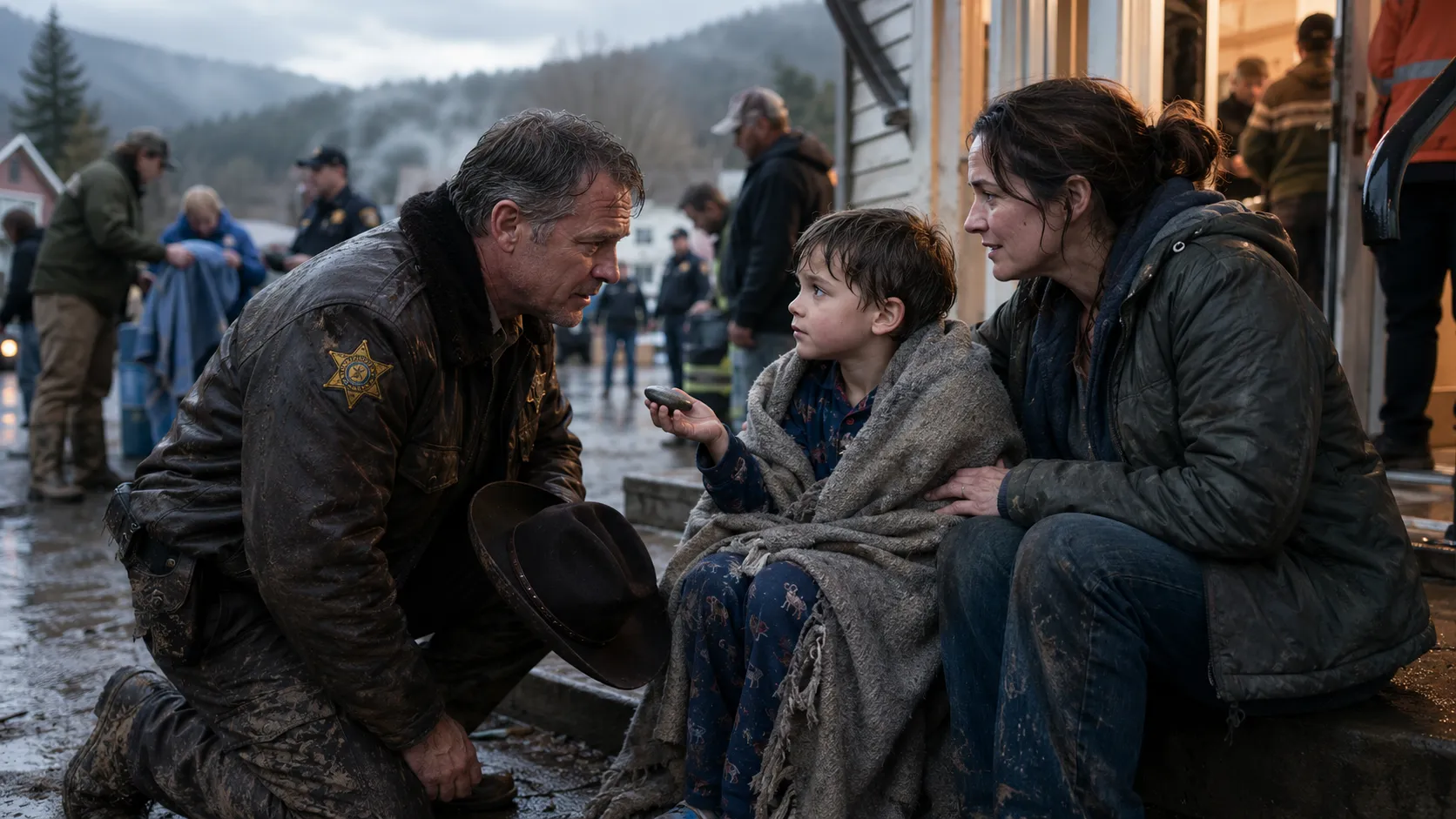
Mason found Sarah sitting on the steps of the shelter with Leo wrapped in a blanket. She would not look at him at first.
“I told people he notices things,” she said quietly. “No one listened.”
Mason removed his sheriff’s hat.
“I didn’t listen either.”
Leo looked up at him.
Mason knelt in the mud.
“I’m sorry, son.”
Leo did not answer, not with words.
He reached into his blanket and handed Mason a small stone.
Then he pointed toward the mountain.
Mason understood.
Not everything was safe yet.
That afternoon, the town finally listened to the silent boy.
Rescue teams followed Leo’s signals and found another weak drainage line before it collapsed. Engineers changed their maps. Families were moved before the second slide came down.
Blackwood Creek survived because the child everyone dismissed kept trying, even after they locked him away.
Months later, the town rebuilt the siren tower.
This time, they added a plaque beneath it.
Not all warnings come with a voice.
Sheriff Mason kept Leo’s small stone on his desk for the rest of his life.
Whenever someone came in with a strange worry, a quiet fear, or a warning that did not fit the paperwork, Mason looked at that stone first.
Then he listened.
Because sometimes the person saying nothing is the one who has been screaming the loudest all along.